
Indoor Enrichment for Cats
November 12, 2025
Dr. Leanne Versteege
Cats are born to move. They have sharp senses, eyesight and flexible bodies that enable them to move with incredible speed, stealth and accuracy. Free roaming cats have a range of habitat that allows them to use their skills and ‘weapons’ to hunt, scavenge for food and interact with other cats. On the contrary, household cats, especially strictly indoor cats (like mine) can be deprived of these environmental stimuli and boredom may set in. Boredom in cats can potentially lead to the above undesirable behaviours. Therefore, we need to make the indoors as interesting as the outdoors. There are a few ways to provide entertainment for them.
Let’s start from feeding:
Please refer to this website for instructions – https://icatcare.org/app/uploads/2019/12/Five-a-day-Felix.pdf
As an ISFM Gold Standard Cat Friendly Clinic, we see every day how strongly a cat’s environment affects their wellbeing. Enrichment isn’t just about entertainment; it supports mental health, reduces stress behaviours, and helps indoor cats stay physically and emotionally balanced.
This is especially relevant for cats living indoors or in apartments across Cranbourne, Lynbrook and Clyde, where space can be limited. Simple changes like vertical spaces, predictable routines, and opportunities to hunt, climb and rest safely can make a meaningful difference.
If your cat still seems withdrawn, anxious, over-grooming or reactive despite enrichment at home, our feline-focused team can help assess what might be contributing and offer practical, cat-specific guidance.
Creating a cat-friendly home environment
As an ISFM Gold Standard Cat Friendly Clinic, we see every day how strongly a cat’s environment affects their wellbeing. Enrichment isn’t just about entertainment; it supports mental health, reduces stress behaviours, and helps indoor cats stay physically and emotionally balanced.
This is especially relevant for cats living indoors or in apartments across Cranbourne, Lynbrook and Clyde, where space can be limited. Simple changes like vertical spaces, predictable routines, and opportunities to hunt, climb and rest safely can make a meaningful difference.
If your cat still seems withdrawn, anxious, over-grooming or reactive despite enrichment at home, our feline-focused team can help assess what might be contributing and offer practical, cat-specific guidance.
Toys are one source of enrichment we can provide for our little furry princes and princesses at home. Knowing what stimulate your cats is based on trial and error. Try to experiment with toys of different texture, noise and smell. My cats absolutely adore fishing rod toys with feathers off the end. To trigger their prey-drive, try moving the toy across their vision or away from the field of vision to simulate a prey running away from them. Dangling the toy in front of them usually doesn’t entice cats as prey doesn’t run to the cat and offer themselves as lunch.
Be careful of hair ties, rubber bands, cable ties or any string like material. Although this could be very entertaining for cats, it can cause an obstruction in their gut if they ingest it.
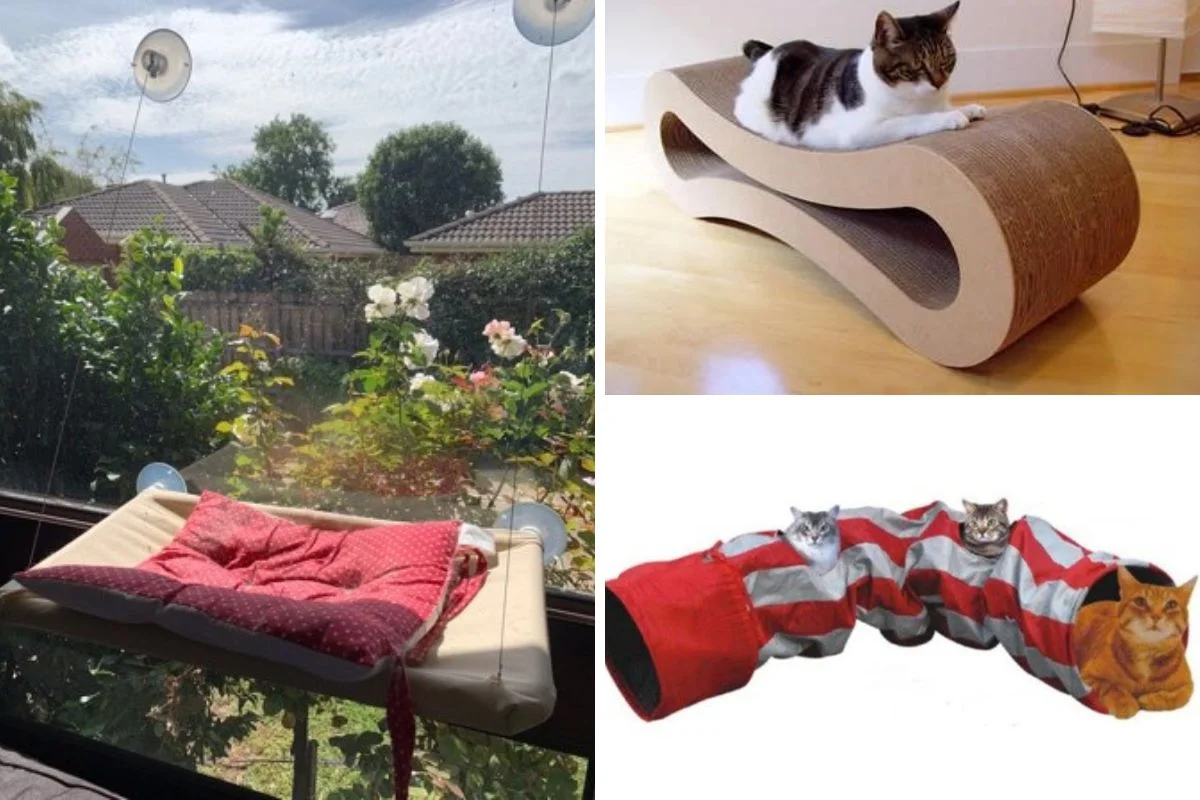
Cats love to have hideaways. Hideaways can be a safe escape for a timid cat but also a fun hide and seek game as well. An igloo shaped hut, A-shaped tent or an empty box is an excellent hideaway. Crumply doughnut shaped tunnels are heaps of fun, especially in a multi-cat household.
You can make your own A-shaped tent using old clothes hangers, cupboard and a used T-shirt.
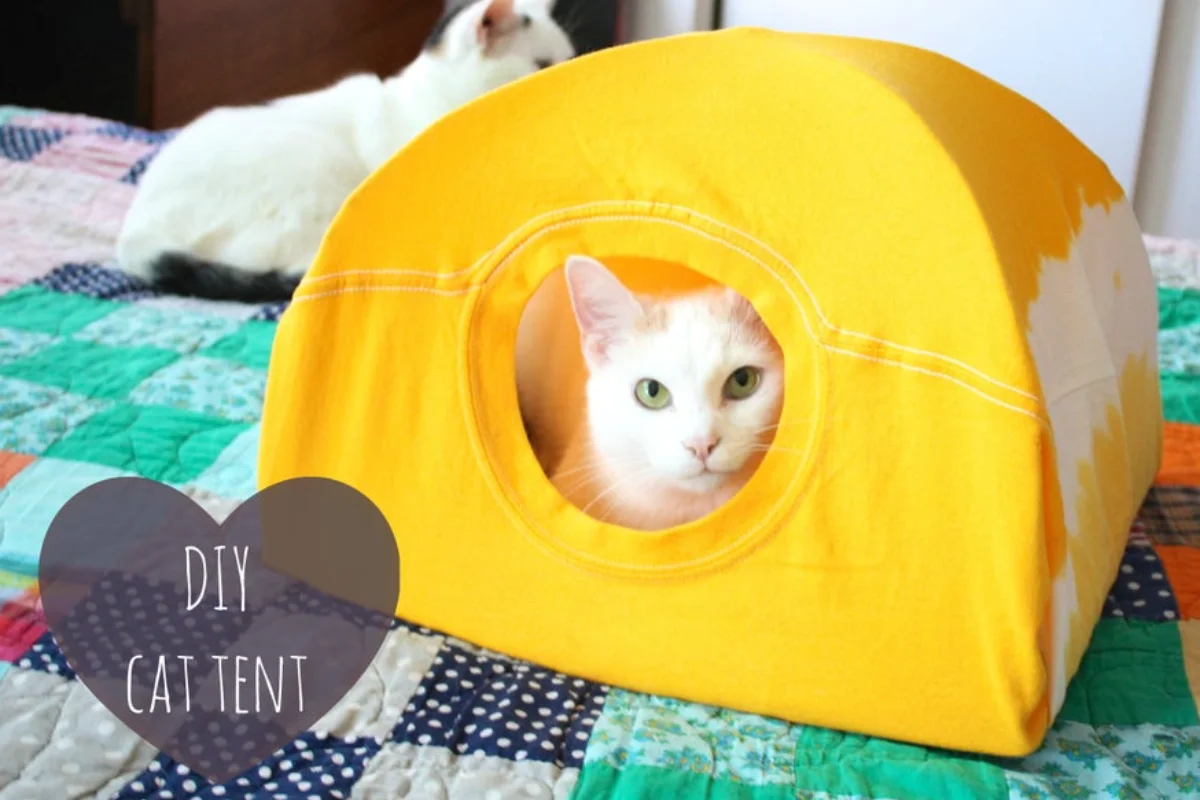
https://www.instructables.com/id/DIY-cat-tent/
As cats are visual animals, we need to provide them with visual stimulus as well. A window hammock is a great bed for cats to rest and to see the world passes by. There are applications of games for cats that you can download. They simulate prey reaction and can keep cats entertained. The most important rule with interactive game play is to end the game in a positive note before your cat gets bored and cats get bored very easily. It is important to not leave any toys out that requires your interaction. Try to rotate toys to prevent boredom. Any toys that are not used should be kept away.
Other than playing, scratching is a very important part of a cat’s life; it helps stretch out their muscles and displaces anxiety. Cats like variety and sometimes vertical scratching posts alone are not enough. Providing your cat with various scratching surfaces on different angles may prevent your cat from destroying your well-loved furniture.
My personal favourite would be cat furniture that is made of cupboard. It not only functions as an excellent scratching surface but also looks good in the living room!
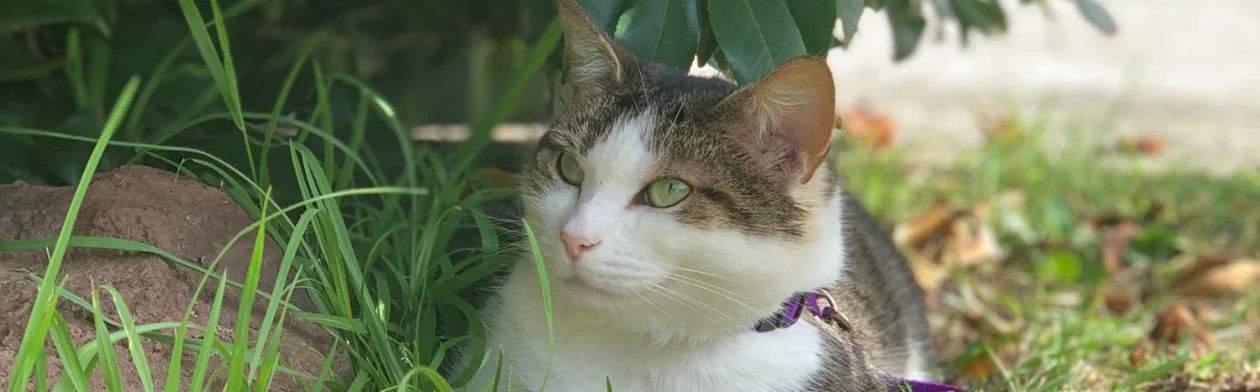
For cats that enjoy being outdoors, you can consider an outdoor enclosure. Many companies make safe outdoor enclosures, ranging from an outdoor portable tent to a complete enclosed backyard. An aviary is a good alternative as some outdoor enclosures can be expensive. If you’re handy, you can set up multi level platforms in the aviary as most cats love to be up high. You could train your cats to get used to a harness and could walk them on a leash. Here is a picture of my cat Skittles relaxing under a bush on a leash.
Bringing things from outdoors such as grass, small twigs, logs or dried leaves indoors could help your cat experience the scent of the outdoors. Logs can also be provided as a scratching tool as well.
Another indoor enrichment will be to train your cats to perform tricks. Yes, you can train your cat. You can train them to sit, high five or even fetch and retrieve light objects. Cats are not as keen to work for praise and attention as dogs are but training your cat does have a few benefits. Training your cat not only stimulates their mind and body but also strengthens the bond you share.
Here are some tips to teach your cat to sit:
With patience, repetition and positive encouragement your cat will be sitting on command in no time.
If you have concerns about your cat’s behaviour or wellbeing, our feline-focused team is here to help.
We see cats from Cranbourne, Clyde, Lynbrook and surrounding suburbs, and offer calm, cat-friendly care at every stage of life.
Contact us to book an appointment or speak with our team.

Learn how to protect your pets from snakes with key safety tips and what to do during an encounter.
Learn how feline hyperthyroidism affects cats, common symptoms, diagnosis options, and effective treatments from Melbourne veterinarians.

Essential tips to prevent pet overheating, recognise heat stress signs and keep your animals cool and safe in hot weather.
Signs of boredom can include excessive sleeping, overeating, vocalising, destructive behaviour or sudden bursts of energy. Some cats also show stress behaviours, such as over-grooming or withdrawal.
Vertical spaces, window perches, puzzle feeders, and toy rotation work well for apartment cats. We often recommend these strategies to cat owners across Cranbourne and Lynbrook, where apartment living is becoming more common.
Yes. Cats who feel confident and stimulated at home often cope better with change. Enrichment supports emotional resilience, which can reduce anxiety during travel and veterinary visits.
Our team at Casey and Cranbourne Veterinary Hospital offers feline-specific behaviour guidance, supported by our ISFM Gold Standard Cat Friendly Clinic accreditation.
If behaviour changes suddenly, worsen, or are paired with appetite, toileting or grooming changes, it’s best to book a health check to rule out underlying medical causes.
Yes. Consistent environmental enrichment can significantly reduce stress-related behaviours in cats by providing mental stimulation, physical activity, and a sense of control within their environment.

Contact Info
Opening Hours
Monday to Friday: 8:00am –
7:00pm
Saturday: 8:00am – 3:00pm
Sunday: CLOSED
Closed on public holidays
For all out-of-hours emergencies,
please contact Veterinary Referral Hospital (VRH) on 1300 385 874
or Casey Pet Emergency on (03) 8790 1625.